请双击输入内容...


Tel: +86-20-86181657

Email: sales@sunrans.com
Share to:


















- Media News -
Beyond Assembly: How Integrated Manufacturing Drives B2B Distributor Success in 2026
Time: 2026-04-15 17:15:56
Author: SUNRANS
Click:
Discover how integrated spa factory advantages solve 2026 distributor challenges: profit margin protection, supply chain stability, and full quality control from acrylic molding to 48-hour testing. CE, ETL, SAA certified.
Introduction: The Distributor‘s Dilemma in 2026
The global spa and wellness industry is booming. According to industry reports, the market is projected to reach $20 billion by 2028, driven by rising health consciousness and demand for home wellness solutions. For B2B distributors, this growth presents an unprecedented opportunity.
But opportunity comes with challenges.
Distributors across Europe, North America, and Australia are facing a perfect storm in 2026. Profit margins are being squeezed from all directions. Supply chains remain unpredictable. Quality inconsistency from fragmented suppliers creates customer complaints and returns. And end customers are more demanding than ever — they want premium products at competitive prices, delivered on time, every time.
The traditional sourcing model — piecing together components from multiple suppliers, relying on trading companies, or working with assembly-only factories — is no longer sustainable.
This article explores how integrated manufacturing — controlling the entire production process under one roof — is becoming the decisive advantage for B2B spa distributors in 2026. We will examine the specific challenges distributors face, how full-process quality control addresses them, and why deep customization capabilities matter for high-standard markets like Switzerland, North America, and Australia.
Part 1: The 2026 Challenges Facing B2B Spa Distributors
1.1 Profit Margins Under Pressure
Distributors have always operated on thin margins. But 2026 has intensified the squeeze.
Rising raw material costs — Acrylic, steel, electronics, and shipping materials have all seen price increases. Traditional trading companies add their own markup, passing higher costs down the chain.
Intense price competition — Online marketplaces and global sourcing platforms have made pricing transparent. End customers can compare quotes from multiple distributors instantly, driving prices downward.
Hidden costs — Poor quality leads to returns and warranty claims. Delayed shipments require expedited shipping. Inconsistent documentation causes customs delays and storage fees.
When a distributor works with a trading company or an assembly-only factory, every intermediary takes a cut. By the time products reach the end customer, the original cost advantage has been diluted multiple times.
1.2 Supply Chain Instability
The post-pandemic era has not brought the supply chain stability many hoped for.
Geopolitical tensions continue to disrupt shipping routes and raw material availability. Labor shortages at ports and factories create unpredictable delays. Energy price volatility affects manufacturing costs, particularly for energy-intensive processes like acrylic thermoforming and foam insulation.
For distributors who rely on multiple suppliers for different components — shells from one factory, frames from another, electronics from a third — any single disruption can halt entire production lines.
Worse, when quality issues arise, tracing the problem back to a specific component supplier becomes a nightmare. The distributor is left holding the bag, answering to unhappy customers while trying to coordinate between multiple unaccountable vendors.
1.3 Quality Inconsistency
Perhaps the most damaging challenge for distributors is inconsistent quality.
A container arrives with beautiful shells but poorly fitted frames. The next shipment has perfect frames but faulty control panels. The third shipment looks fine on the surface but develops leaks after three months of use.
Each quality failure erodes customer trust, generates costly returns, and damages the distributor‘s brand reputation. In the spa industry, where products are large, heavy, and expensive to ship, returns are particularly painful.
When distributors work with assembly-only factories, quality control is often an afterthought. These factories purchase components from the lowest bidder and assemble them without rigorous testing. There is no accountability for component quality because the factory does not manufacture the components itself.
Part 2: The Integrated Manufacturing Advantage – What Three Factories Really Mean
2.1 From Acrylic Sheet to Finished Spa: Complete Vertical Integration
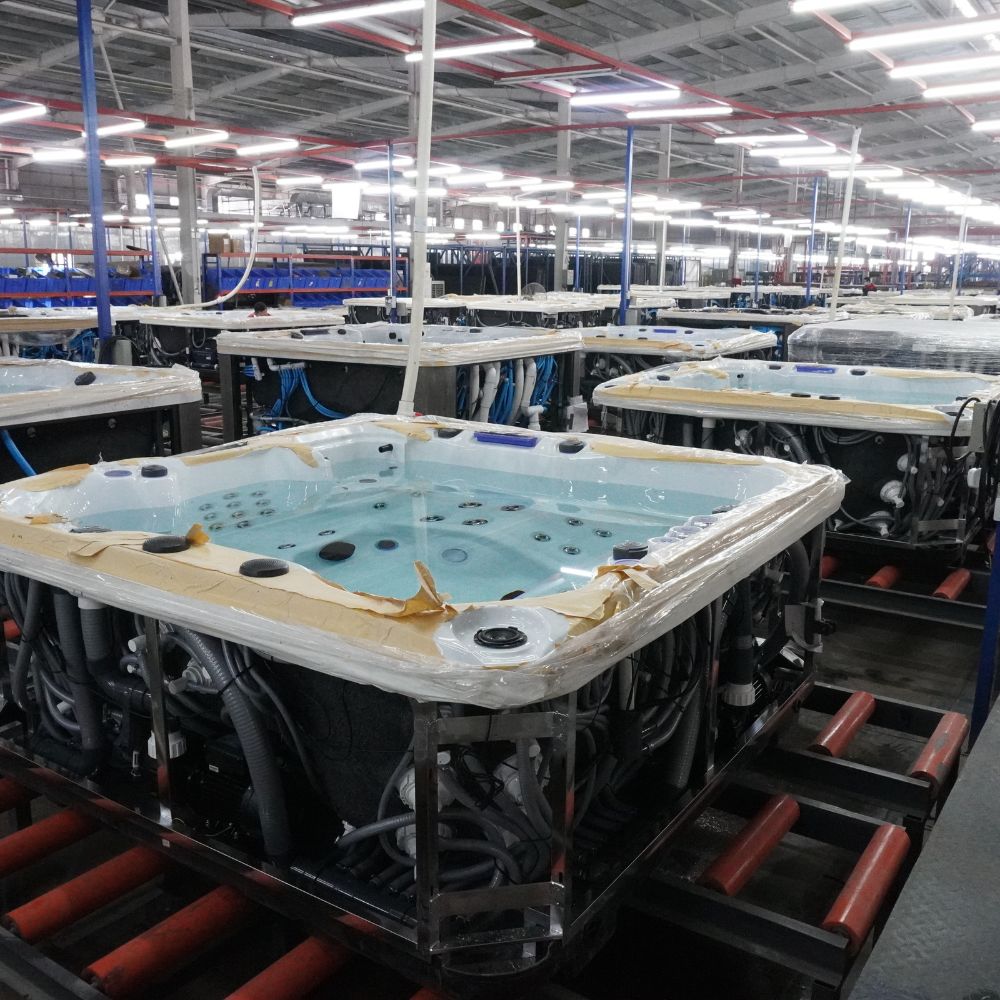
Sunrans operates three advanced production bases across China, with a total factory area exceeding 114,000 square meters. But scale alone is not the advantage — it is what happens inside those factories that matters.
Vertical integration means that every critical component of a spa or swim spa is manufactured in-house:
- Acrylic thermoforming — Raw acrylic sheets from US Aristech enter the factory. Our molding machines shape them into precise, seamless shells. No outsourcing, no quality variance.
- Frame fabrication — #304 stainless steel is cut, welded, and assembled on-site. No rust, no weak joints, no third-party shortcuts.
- Plumbing assembly — Every pipe, jet, and valve is installed by trained technicians following standardized layouts. No guessing, no improvised connections.
- Electrical integration — Control panels, pumps, heaters, and lighting systems are wired and tested together. No compatibility issues between components from different suppliers.
- Foam insulation — Full-coverage foam is applied in-house, ensuring consistent thickness and complete cavity filling. No cold spots, no energy waste.
This end-to-end control creates a single point of accountability. When a distributor places an order with Sunrans, there is no finger-pointing between suppliers. One factory, one quality standard, one delivery timeline.
2.2 The 48-Hour Water Test: Quality You Can Trust
In the spa industry, water is both the product‘s purpose and its greatest risk. A spa that leaks is not just defective — it is potentially destructive to the customer‘s property.
Sunrans has implemented a mandatory 48-hour water test for every single unit before it leaves the factory.
Here is what that means in practice:
If a unit fails any test, it does not ship. It goes back to the production line for diagnosis and repair, then re-enters the testing queue.
For distributors, this means dramatically reduced warranty claims, fewer customer complaints, and lower after-sales service costs. The 48-hour test is expensive and time-consuming. But it is also the reason why Sunrans distributors report significantly lower defect rates compared to industry averages.
2.3 100% Inspection, Not Spot Checking
Many factories claim quality control, but they rely on statistical sampling — testing a small percentage of units and assuming the rest are fine.
Sunrans practices 100% full inspection. Every component, every sub-assembly, every finished spa is inspected before moving to the next production stage.
- IQC (Incoming Quality Control) — Raw materials are tested upon arrival. Acrylic thickness, steel gauge, electronic component function — all verified before entering the production line.
- IPQC (In-Process Quality Control) — During assembly, inspectors check each stage. Frame alignment, plumbing connections, electrical terminations — any deviation is corrected immediately.
- FQC (Final Quality Control) — Before packaging, every finished unit undergoes the full 48-hour test protocol.
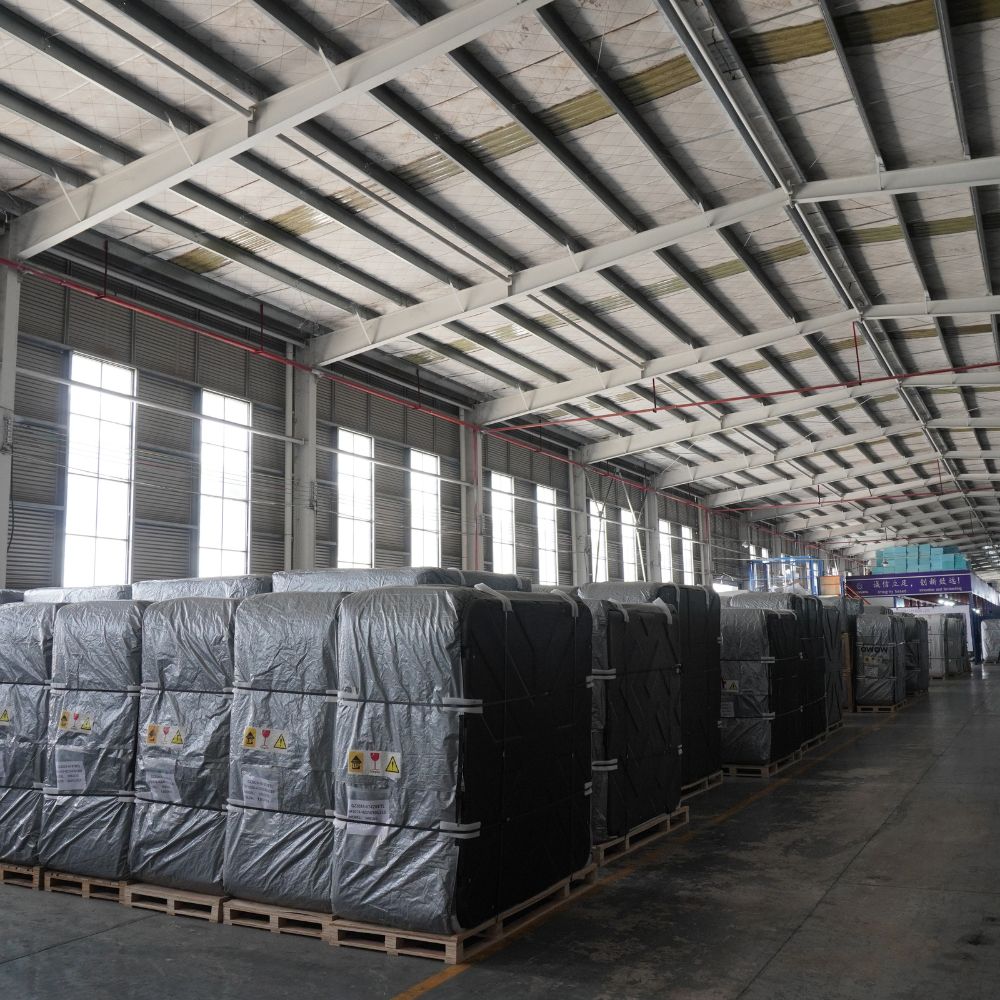
- OQC (Outgoing Quality Control) — Before loading into containers, packaged units are inspected for correct labeling, proper packaging, and shipping readiness.
This four-stage quality system creates a documented trail for every unit. If a distributor ever receives a product with an issue, we can trace it back to the specific production batch, the responsible technician, and the inspection records.
Part 3: Deep Customization for High-Standard Markets
3.1 Meeting the Demands of Switzerland, North America, and Australia
Different markets have different expectations. A spa that sells well in Florida might fail in Zurich. A design that appeals to Australian homeowners might not resonate with Canadian buyers.
Sunrans has developed deep customization capabilities specifically to address the unique requirements of premium markets.
Switzerland & European Market:
- Preference for compact, energy-efficient designs
- Demand for minimalist aesthetics and natural materials
- CE certification mandatory
- RoHS compliance for environmental standards
North American Market:
- Larger dimensions and higher jet counts
- ETL/UL certification required for electrical safety
- Preference for powerful pumps (3.0HP+)
- Demand for LED lighting packages and Bluetooth audio
Australian Market:
- SAA certification for electrical compliance
- UV-resistant acrylic to withstand harsh sun
- Energy efficiency priorities due to high electricity costs
- Durability requirements for transport over long distances
3.2 OEM/ODM Capabilities: Your Brand, Our Factory
For distributors building their own brand identities, Sunrans offers comprehensive OEM (Original Equipment Manufacturing) and ODM (Original Design Manufacturing) services.
The MOQ for custom projects is flexible. For standard customizations like colors and logos, we can accommodate smaller orders. For full design changes, we work with distributors to find the right balance between customization and cost efficiency.
3.3 Compliance Without Compromise: CE, ETL, UL, SAA
In 2026, regulatory compliance is non-negotiable. Customs delays, product seizures, and legal liabilities await distributors who cut corners on certification.
Sunrans products are certified for the world‘s most demanding markets:
When distributors partner with Sunrans, they receive products that are ready to sell in their target markets. No last-minute certification scrambling. No customs holds. No legal exposure.
Part 4: Why Integrated Manufacturing Wins in 2026 and Beyond
4.1 Price Stability Through Vertical Integration
When a distributor works with an integrated manufacturer, they are insulated from supply chain volatility.
If acrylic prices rise, a trading company raises its prices immediately. An integrated manufacturer absorbs some of the increase through efficiency gains elsewhere in the production process.
If shipping costs spike, an assembly-only factory passes the full increase to the distributor. An integrated manufacturer with high container volume negotiates better rates and can stabilize pricing.
This stability allows distributors to quote confidently to their end customers, build predictable margins, and avoid the constant renegotiation that erodes trust.
4.2 Shorter Lead Times, Better Inventory Management
Integrated manufacturing means no waiting for components from multiple suppliers. When all production happens under one roof, schedules are predictable.
Sunrans standard lead times:
For distributors, predictable lead times translate to lower inventory carrying costs, fewer stockouts, and the ability to offer reliable delivery dates to end customers.
4.3 One Point of Accountability
Perhaps the most underappreciated advantage of integrated manufacturing is accountability.
When a distributor works with a trading company, problems become a game of telephone. The distributor calls the trader. The trader calls the factory. The factory calls its component suppliers. By the time an answer comes back, weeks have passed and the customer is furious.
When a distributor works with Sunrans, there is one phone number to call. One person to hold responsible. One company that owns the outcome.
This accountability builds trust. And in the B2B distribution business, trust is the most valuable currency.
Conclusion: The Integrated Advantage
The B2B spa distribution landscape in 2026 favors partners who can deliver quality, stability, and customization at scale.
Distributors who continue to rely on fragmented supply chains and assembly-only factories will struggle with margin erosion, quality inconsistency, and customer churn.
Those who partner with integrated manufacturers like Sunrans gain:
- Full quality control from raw material to finished product
- Supply chain stability through vertical integration
- Deep customization for high-standard markets
- Regulatory compliance with CE, ETL, UL, and SAA
- One point of accountability for every order
The future of B2B spa distribution belongs to integrated manufacturing. The question is not whether to make the shift, but how quickly.
About Sunrans
Sunrans (Huizhou) Health Technology Co., Ltd. is an integrated manufacturer of premium spas, swim spas, and wellness equipment. With nearly 20 years of experience, 100+ patents, and three production bases, we serve distributors in over 80 countries across Europe, North America, and Australia.

点击右上角
分享给朋友吧







 Long by picture save/share
0

English
- 中文
- English
Share to:  |
|
Copyright© GUANGZHOU SUNRANS SANITARY WARE CO.,LTD
粤ICP备17099389号-2
Contact us
Tel: +86-20-86181657 Email: sales@sunrans.com
Share to
Contact us Tel: +86-020-26231998 Email: sales@sunrans.com Post code: 511300
Copyright © GUANGZHOU SUNRANS SANITARY WARE CO.,LTD 粤ICP备17099389号
